You can change GP while you wait for a hospital appointment. Existing referrals and waiting list places usually stay with the hospital. Check your referral with the hospital team before you register, then tell them about your new GP surgery. Registering somewhere new moves your GP care there.
In short:
- Your hospital referral usually stays with the hospital when you change GP.
- Check with the hospital team first, especially if you're moving to a new area.
- Once you're registered, tell the hospital about your new GP surgery.
- Staying with your current GP surgery is also a choice.
A hospital letter says you're on a waiting list. Then you move house, or a GP surgery nearer to you has space. Will changing GP send you back to the start?
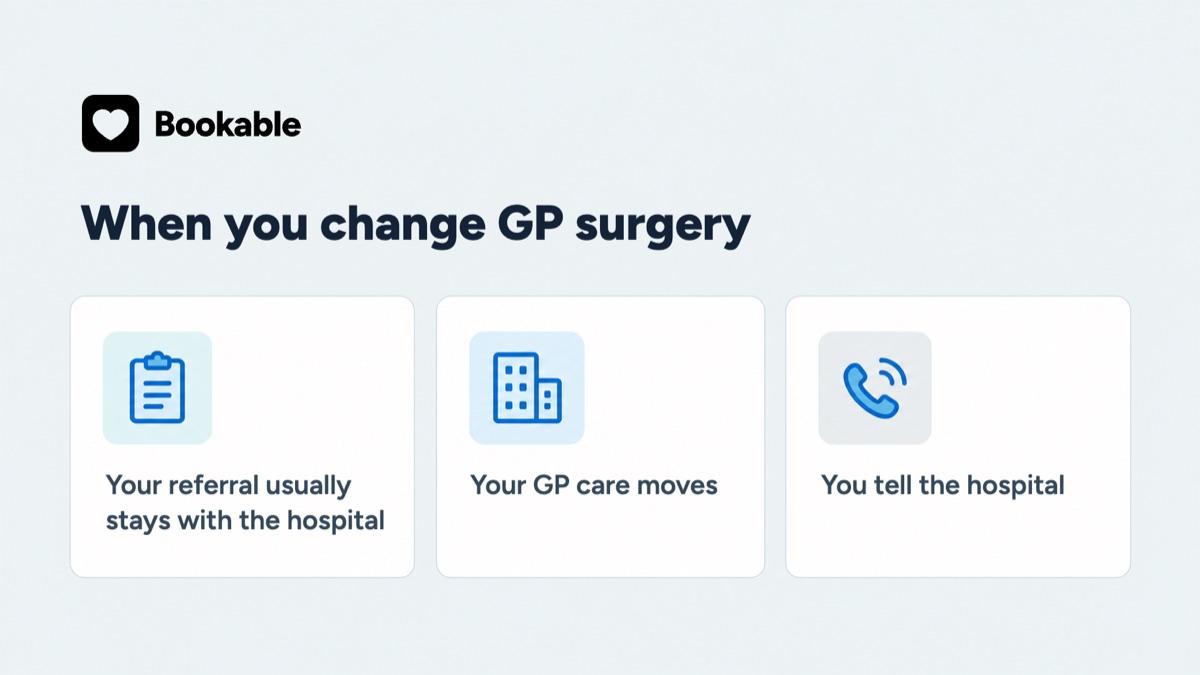
Usually not. You can change GP while you wait for a hospital appointment. Changing your GP does not automatically change your hospital care.
What needs care is where your hospital letters go. A short handover, done in the right order, helps them reach the right place.
Will changing GP affect my hospital appointment?
Not usually. Existing referrals and waiting list places usually stay with the hospital when you change GP surgery. The hospital or specialist service is the one that will see you, so ask them if you're unsure.
You can read the NHS Choice Framework (opens in a new tab) for more information about your choices while you wait.
Do not cancel your hospital appointment because you're changing GP. Depending on the hospital, cancelling can take you off the waiting list, and you would then need a new referral. You can read the NHS App help page on hospital referrals and appointments (opens in a new tab) for more information.
What changes when you register with a new GP surgery
Your GP care moves. When you register with a new GP surgery, you're removed from your old surgery's list and your everyday GP care moves there. If you want to go back later, you would need to register with your old surgery again.
Hospitals usually share letters and care plans with you and with your GP surgery. These become part of your GP record.
Hospitals can use national NHS records to see which GP surgery you're registered with. Even so, tell the hospital yourself, so their details for you are up to date.
Our guide on how to book a GP appointment explains what else moves when you change GP surgery.
Check your referral before you move
Before you register, contact the hospital team who are looking after you. Look for their contact details on the letters the hospital sent you. For questions about a hospital appointment, you may need to contact the hospital directly rather than your GP surgery.
You can ask them:
- whether changing GP will affect your referral
- whether anything changes if you're moving to a new area
- how to give them your new GP surgery's details
- who to contact if your health changes while you wait
Checking first matters most if you're moving to a different area or if you're part way through specialist care.
If you cannot reach the hospital team, try the Patient Advice and Liaison Service (PALS) (opens in a new tab) at the hospital. PALS is a point of contact for patients, families and carers, and can help with questions about your care.
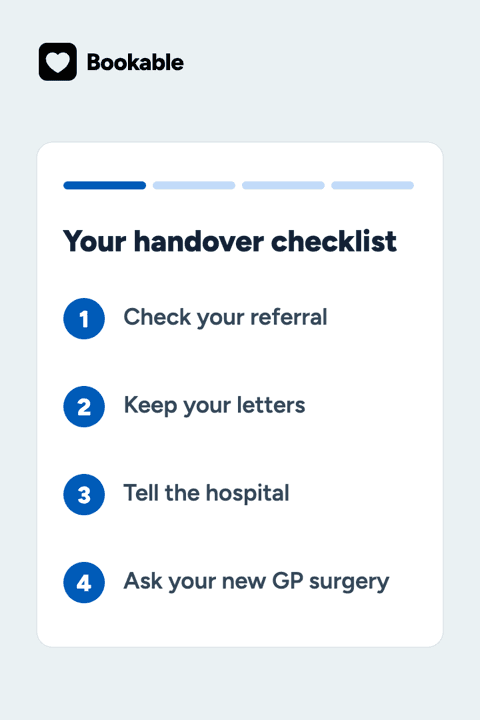
Your handover checklist
Do these steps in order. The first 2 happen before you register with your new GP surgery, and the last 2 happen after.
- Check your referral with the hospital team before you register.
- Keep your letters, any booking reference number and the hospital team's contact details to hand.
- Tell the hospital team about your new GP surgery once you're registered.
- Ask your new GP surgery how they receive hospital letters, and tell them about your referral.
Some referrals are booked through the NHS e-Referral Service (opens in a new tab), an NHS system for booking hospital and clinic appointments online. To manage that appointment, you need your booking reference number and password or access code. If you do not have them, contact the person or organisation that referred you.
Once you've checked with the hospital, you can search for NHS GP surgeries near your new home on Bookable. At the GP surgeries we partner with, you pick an appointment and register at the same time. GP surgeries decide whether to accept a registration, and Bookable is free to use.
Our guide on how to register with a GP explains who can register and what you need.
If you're moving to a different area
Changing GP does not automatically change your hospital care. Before you register, ask the hospital team what a move to a new area means for your referral, and what your options are.
You can also ask whether any part of your care depends on where you live, such as community services.
For new health needs, your new GP can refer you to local hospitals as needed. This is separate from the referral you already have.
If your health changes while you wait
Contact the hospital team about anything to do with your hospital care. Your care plan letter may say who to contact if your health changes.
Once you're registered, your new GP surgery looks after your everyday GP care. If you need medical help and it is not an emergency, use NHS 111 online (opens in a new tab) or call 111. In an emergency, call 999 or go to A&E.
Staying with your current GP surgery is also a choice
You do not have to change GP. If your new home is still inside your surgery's area, you can usually stay and tell them your new address.
Some surgeries also accept patients who live outside their area. This may affect home visits, urgent and out-of-hours care from your GP, and community services like physiotherapy. Ask the surgery what would apply to you.
Living away from home for a while? You can register with a nearby GP surgery as a temporary patient for up to 3 months, and stay registered with your own. You can read the NHS guide to registering with a GP surgery (opens in a new tab) for more information.
Whichever you choose, the handover is the same. Check your referral with the hospital team and keep your letters to hand. Once you're registered somewhere new, tell the hospital.
Common questions
Will I lose my place on a hospital waiting list if I change GP?
Usually not. Existing referrals and waiting list places usually stay with the hospital when you change GP surgery. Check with the hospital team before you change, and do not cancel your hospital appointment because you're moving GP surgery.
Who do I tell about my new GP?
Tell the hospital team who are looking after you, using the contact details in your hospital letters. Tell your new GP surgery about your referral too. You do not need to tell your old GP surgery, because they're told once you're registered somewhere new.
Do I need a new referral from my new GP?
Not usually for a referral you already have, because it stays with the hospital. Your new GP can refer you to local hospitals for new health needs. If you're not sure, ask the hospital team.
What if I have waited a long time for hospital treatment?
You may have waited, or expect to wait, more than 18 weeks for non-urgent treatment led by a consultant (a senior hospital doctor). If so, you can ask to be referred to a different hospital or service, although there are exceptions. Contact the hospital or your local integrated care board (ICB), which plans NHS services in your area.
Sources
- Changing GP or address (opens in a new tab) (Bookable)
- Booking appointments (opens in a new tab) (Bookable)
- Getting started and registration (opens in a new tab) (Bookable)
- Bookable homepage and common questions (opens in a new tab) (Bookable)
- Register with a GP surgery (opens in a new tab) (NHS)
- The NHS Choice Framework: what choices are available to me in the NHS? (opens in a new tab) (Department of Health and Social Care)
- Hospital referrals and appointments: NHS App help (opens in a new tab) (NHS)
- Referrals for specialist care (opens in a new tab) (NHS)
- You and your general practice (opens in a new tab) (NHS England)
- Patients registered with GP practices (opens in a new tab) (NHS England)
- Preparing for my appointment (opens in a new tab) (My Planned Care (NHS England))
- Book a hospital or clinic appointment using the NHS e-Referral Service (opens in a new tab) (NHS)
- What is PALS (Patient Advice and Liaison Service)? (opens in a new tab) (NHS)
- NHS 111 online (opens in a new tab) (NHS)
- Terms of Use (opens in a new tab) (Bookable)